Does Gambling Self-Exclusion Really Work? What Happens After Bettors Ban Themselves


- Key Findings
- What Is Gambling Self-Exclusion?
- How Does Self-Exclusion Work?
- Operator-Specific vs National Self-Exclusion
- How Is Self-Exclusion Different From Other Gambling Controls?
- Why Are Governments Introducing National Self-Exclusion Registers?
- One Registration Can Block an Entire Licensed Market
- Centralized Identity Checks Make the Restriction Enforceable
- Self-Exclusion Is Increasingly Treated as Harm Prevention
- Registrations Are Not the Same as Successful Outcomes
- How Does Gambling Self-Exclusion Work Around the World?
- Great Britain: Gamstop Online and Separate Retail Schemes
- Sweden: Spelpaus and the Offshore Gap
- The Netherlands: Connecting Online and Land-Based Gambling
- Brazil: Self-Exclusion as Digital Public Infrastructure
- Russia: A New Self-Exclusion Experiment
- Does Gambling Self-Exclusion Actually Work?
- It Can Interrupt Impulsive Gambling
- Many Users Gamble Less and Report Improved Wellbeing
- Some People Continue Gambling During Their Exclusion
- Longer Exclusion Periods May Be More Effective
- Where Does Self-Exclusion Fall Short?
- Unlicensed and Overseas Gambling Remains Accessible
- One Register May Not Cover Every Gambling Product
- Enforcement and Identity Checks Can Fail
- Self-Exclusion Requires the Person to Act First
- Does Self-Exclusion Push People toward Other Costly Activities?
- Gambling Displacement
- Addiction Substitution
- Healthy Replacement Activities
- What Makes a Self-Exclusion System Effective?
- One Registration Across the Regulated Market
- Fast and Enforceable Restrictions
- Direct Connections to Treatment and Financial Help
- Transparent Measures of Success
- Self-Exclusion Works Better as Part of a Recovery Plan
- Is Gambling Self-Exclusion Ultimately a Success?
- Frequently Asked Questions
- Does Gambling Self-Exclusion Really Work?
- What Happens When You Self-Exclude From Gambling?
- Can You Cancel Gambling Self-Exclusion Early?
- Can a Self-Excluded Person Still Gamble Online?
- Is Self-Exclusion the Same as Gambling Treatment?
- Does Gambling Self-Exclusion Affect Your Credit Score?
- How Can Operators Better Protect Self-Excluded Players?
Gambling self-exclusion is designed to create a hard barrier between a bettor and further gambling. Depending on the system, it can block access to licensed online accounts, apps, and physical venues, while also restricting marketing and new registrations.
The evidence suggests that self-exclusion can reduce gambling activity and related harm, but it should not be treated as a complete solution. It does not remove the underlying triggers behind harmful gambling, and some users continue through offshore sites, uncovered products, or other channels.
That raises the more important question: what actually happens after someone self-excludes? Now, we will examine how national systems work, what research says about their effectiveness, where they fail, and whether stopping gambling leads to recovery, displacement, or substitution into other costly behaviors.
Key Findings
- A systematic review found 13%–81% abstinence, 29%–92% reductions in gambling, and 8%–59% exclusion breaches.
- In a 2024 independent Gamstop Online evaluation, 78% of users said the service delivered the result they wanted, while around three-quarters felt more in control of their gambling.
- Swedish research found that 49% of surveyed Spelpaus users had gambled at least once during an exclusion.
- A study of 3203 British online casino players found that more than 99% of those choosing exclusions longer than 90 days had not returned during the study period.
- Brazil recorded more than 1.2 million self-exclusion requests by August 2026, which shows how quickly national registers can become a major part of public gambling policy.
What Is Gambling Self-Exclusion?
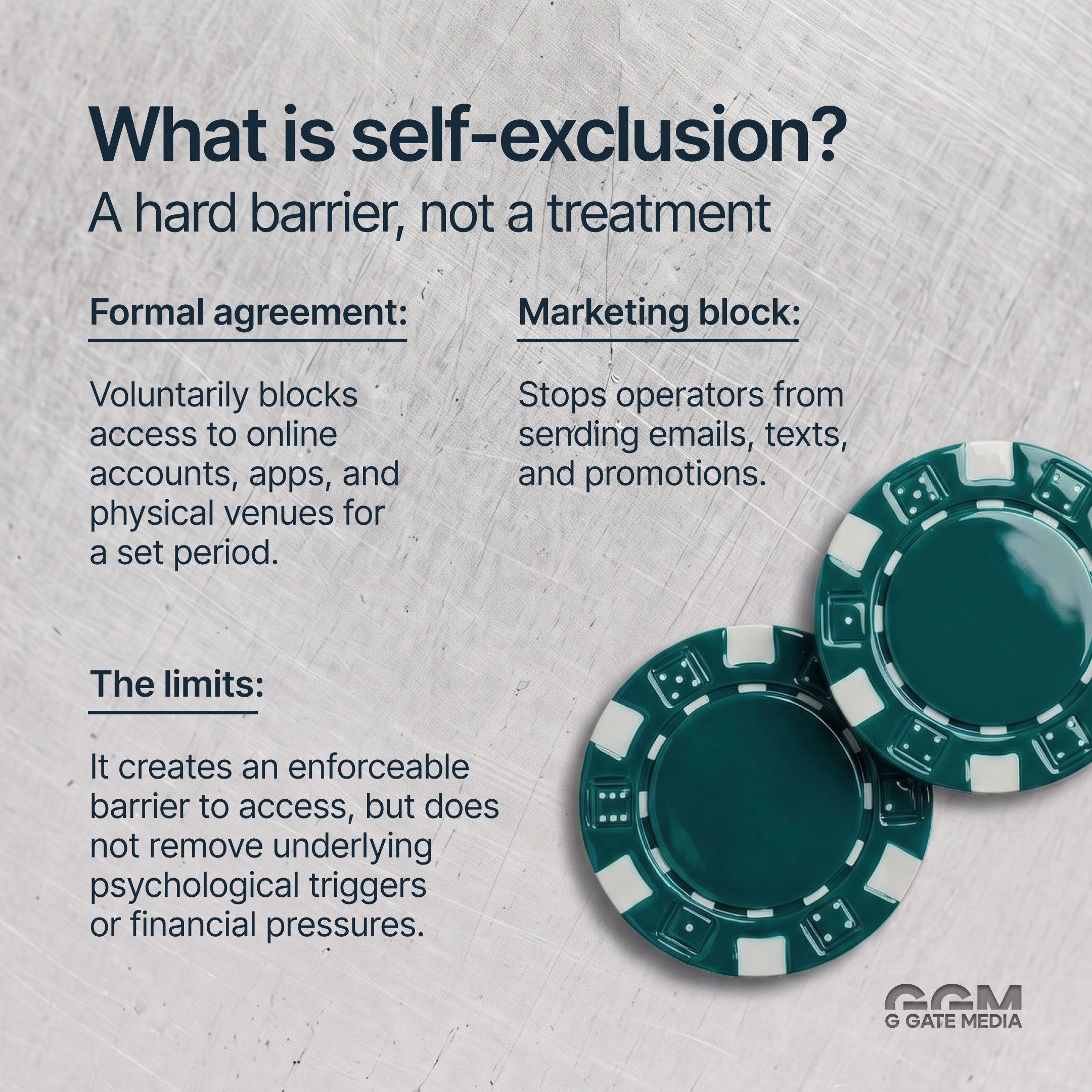
Voluntary gambling self-exclusion is a formal agreement in which a person asks to be prevented from gambling for a defined period. It can apply to online betting and casino accounts, gambling apps, and physical venues such as betting shops, casinos, bingo halls, and arcades.
Unlike simply deciding to take a break, self-exclusion creates an enforceable barrier within the gambling system it covers.
How Does Self-Exclusion Work?
Once someone self-excludes, operators are expected to stop them from gambling during the chosen period. In Great Britain, licensed operators must close the account, return remaining funds, and take reasonable steps to prevent further gambling.
Marketing should stop as well. British operators must take reasonable steps to remove or flag self-excluded customers in their marketing databases so they are not encouraged back through emails, texts, or promotions.
Exclusion periods depend on the scheme. Gamstop Online currently offers minimum periods of six months, one year, five years, or five years with automatic renewal. The minimum period cannot simply be canceled once it has started.
Operator-Specific vs National Self-Exclusion
Some systems apply only to one operator or venue. Others cover multiple businesses through one registration.
This difference is important. An operator-specific exclusion may stop access to one betting site or casino while leaving other licensed operators available. A multi-operator or national system closes more of those gaps.
Gamstop Online, for example, covers gambling websites and apps run by operators licensed in Great Britain through a single registration.
How Is Self-Exclusion Different From Other Gambling Controls?
Self-exclusion is stronger than most day-to-day gambling controls because it is designed to remove access rather than simply limit it.
A time-out is a shorter break. In Great Britain, online time-outs can last up to six weeks.
A deposit limit restricts how much money can be paid into a gambling account over a set period. It does not necessarily stop the person from gambling with funds already available.
Bank gambling blocks target payments, while blocking software can restrict access to gambling websites and apps on a device. These barriers operate at different points, which is why support organizations often recommend layering them together.
Self-exclusion is therefore best understood as a barrier to access, not as treatment in itself. It can make gambling harder to reach, but it does not automatically remove the triggers, habits, or financial pressures behind harmful gambling.
Why Are Governments Introducing National Self-Exclusion Registers?
Governments are moving toward national self-exclusion systems because blocking one gambling account often leaves the rest of the regulated market open.
That is the central weakness of operator-by-operator exclusion. A person may close one sportsbook or casino account and still have access to several others. A central register turns that individual restriction into a market-wide barrier.
One Registration Can Block an Entire Licensed Market
Sweden shows how this model works. Operators offering registered gambling under a Swedish license must connect to the national Spelpaus system and check whether a player is excluded before allowing them to gamble. A registration applies across licensed gambling that requires player registration, rather than one chosen operator.
Brazil has adopted a similar centralized approach for federally authorized betting platforms. Its system can close active betting accounts, prevent individuals from using their Brazilian taxpayer identification numbers (CPFs) to open new accounts, and stop targeted betting advertising.
That is a much stronger barrier than asking someone experiencing gambling harm to find and exclude from every operator separately.
Centralized Identity Checks Make the Restriction Enforceable
A national register only works if operators can reliably identify the person who has excluded themselves.
Swedish licensees must check Spelpaus before allowing registered gambling. Brazil connects its central system to a verified Gov.br account and uses the bettor’s CPF to apply the restriction across authorized operators.
This changes self-exclusion from a request stored with one company into a regulatory control that follows the individual across the licensed market.
It also makes prevention possible at several points. Existing accounts can be blocked, new registrations can be rejected, and marketing can be suppressed before it reaches the excluded person.
Self-Exclusion Is Increasingly Treated as Harm Prevention
The policy goal is broader than simply closing gambling accounts.
Brazil’s Ministry of Health includes self-exclusion among its harm-reduction measures and places it alongside spending limits, breaks, social support, and professional care. The Ministry of Finance similarly describes responsible gambling rules as measures intended to prevent and mitigate financial, emotional, and social harm.
This is an important distinction. It treats gambling harm as a consumer-protection and public-health issue, rather than leaving the entire responsibility with the bettor.
But self-exclusion is still only one intervention. A register can restrict access to regulated gambling. It cannot by itself resolve debt, emotional triggers, compulsive behavior, or other factors that may have contributed to harmful gambling.
Registrations Are Not the Same as Successful Outcomes
A large number of registrations can show that people know about a scheme and are willing to use it. This does not, on its own, prove that gambling harm has fallen.
That distinction matters when governments assess whether these systems work.
A meaningful evaluation should ask what happens after registration. Are users gambling less? Are exclusion attempts being blocked? Are financial and psychological harms improving? Are people moving toward unlicensed gambling? Do they receive treatment or other support?
Registration totals are therefore best understood as a measure of uptake, not effectiveness.
The real test of a national self-exclusion system is whether the system reduces gambling exposure and produces measurable reductions in harm.
How Does Gambling Self-Exclusion Work Around the World?
Gambling self-exclusion works differently around the world, but the best systems use one central register to block access across much of the licensed market.
The details vary by country. Great Britain, Sweden, and the Netherlands already have established schemes, while Brazil and Russia are building newer models with broader national coverage. The key differences are who is covered, how long exclusions last, and whether online and land-based gambling are connected.
| System | Country | Coverage | Duration | Main Gap |
| Gamstop Online + retail schemes | Great Britain | Online + separate retail schemes | 6 months to 5+ years | Fragmented by channel |
| Spelpaus | Sweden | Most licensed registered gambling | 10 days to indefinite | Offshore gap |
| Cruks | Netherlands | Online + casinos + gaming halls | 6 months to 99 years | Relies on correct checks |
| Central Platform | Brazil | Federally authorized betting | 1–12 months or indefinite | Limited to regulated betting |
| National Register | Russia | Bookmakers, totalisators, casinos | Minimum 12 months | Too new to judge |
Great Britain: Gamstop Online and Separate Retail Schemes
Great Britain has a mature self-exclusion framework, but it is split by gambling channel.
Gamstop Online covers online gambling. All online operators licensed in Great Britain must participate, and registered users should be blocked from opening or using accounts with those companies.
Land-based gambling uses separate schemes:
- Betting shops: Gamstop Betting Shops
- Casinos: SENSE (Self-Enrolment National Self-Exclusion)
- Bingo: BISES (Bingo Industry Self-Exclusion Scheme)
- Arcades and adult gaming centers: sector-specific multi-operator schemes
The Gambling Commission requires premises operators to participate in relevant multi-operator self-exclusion arrangements.
The online system also has evidence behind it. A 2024 independent Ipsos evaluation surveyed more than 4650 Gamstop Online users. 78% said the service had delivered the results they wanted, while around three-quarters said they felt more in control of their gambling. Users also reported improvements in areas such as finances, relationships, and health.
The main limitation is fragmentation. Someone who wants to block online gambling, betting shops, casinos, and bingo may still need several separate exclusions. The Gambling Commission notes that land-based schemes usually cover the same type of gambling, rather than every gambling channel through one universal register.
Sweden: Spelpaus and the Offshore Gap
Sweden’s Spelpaus is a nationwide self-exclusion register covering licensed gambling that requires player registration. One registration can block access to online casino, betting, bingo, and other licensed products, while also stopping direct gambling marketing.
Players can exclude for:
- 10 days
- One, three, or six months
- Until further notice, with a minimum of 12 months
The chosen period cannot be canceled early.
Swedish research shows why the system matters, but also where it struggles. A 2024 qualitative study found that many users saw Spelpaus as a useful barrier, while still pointing to loopholes and weak links between exclusion and treatment.
The biggest gap is offshore gambling. In a survey of 1505 past-year gamblers, 49% of respondents who had used Spelpaus said they had gambled at least once during an exclusion. Overseas operators outside the Swedish licensing system were identified as one route around the restriction.
So Spelpaus is massive within the licensed market. Its weakness begins where Swedish regulation ends.
The Netherlands: Connecting Online and Land-Based Gambling
The Netherlands uses Cruks, a central self-exclusion register that connects online gambling with physical casinos and gaming halls. Licensed operators must check the register before allowing a player to gamble. If Cruks returns a match, access must be refused.
That means one exclusion can cover:
- Licensed online gambling sites
- Holland Casino
- Licensed gaming halls
The Dutch regulator says a voluntary gambling stop can last from 6 months to 99 years. It cannot be ended during the first six months. After that, an early cancellation request triggers an eight-day cooling-off period before the exclusion can actually end.
This joined-up model is Cruks’ biggest strength. A person does not need one exclusion for an app and another for the casino down the road. The same register follows them across major regulated online and land-based channels.
It is not flawless. In 2026, the regulator warned one online operator after a technical problem meant some Cruks checks were missed, showing that a central register is only as strong as the identity checks and operator systems behind it.
Brazil: Self-Exclusion as Digital Public Infrastructure
Brazil has taken a very digital approach to self-exclusion. Its Centralized Self-Exclusion Platform, run by the Ministry of Finance’s Secretariat of Prizes and Betting (SPA/MF), lets a person block themselves from all federally authorized fixed-odds betting platforms through one government service. Access requires a verified Gov.br silver or gold account.
Once registered, the system can:
- Close active betting accounts
- Stop the same CPF being used for new registrations
- Block targeted betting advertising
Uptake has been substantial. By August 13th, 2026, the Ministry of Finance reported more than 1.2 million self-exclusion requests. Almost 36% cited loss of control over gambling and mental health as the main reason, while around two-thirds chose an indefinite exclusion.
Those numbers should not be mixed with government-imposed restrictions. Brazil separately blocks some people from betting because of measures involving social-benefit recipients and debt renegotiation. Those are legal restrictions imposed by the state, not voluntary self-exclusion.
Russia: A New Self-Exclusion Experiment
Russia’s national self-exclusion register is much newer. The legal framework took effect on September 1st, 2026, so it is far too early to make serious claims about whether it works. The underlying rules were enacted through Federal Law No. 575-FZ and published on Russia’s official legal-publication portal.
Individuals can ask to be added to a central register maintained by the Unified Gambling Regulator. Applications can be submitted through the Gosuslugi state-services portal or multifunctional government service centers, and the exclusion must last for at least 12 months.
Once a person appears on the register, regulated operators must refuse:
- Bets and interactive bets
- Access to gambling venues and betting accounts
- Certain gambling transactions
- Direct gambling advertising
The rules cover bookmakers and totalisators and also restrict access to regulated casinos and gaming-machine halls.
For now, we see Russia more as an experiment rather than a success story. The useful measures will come later: how many people register, whether operators consistently enforce the blocks, whether advertising really stops, and whether excluded users move toward illegal gambling instead.
Does Gambling Self-Exclusion Actually Work?
It works for many people, but the answer depends on how success is measured.
We checked systematic reviews, real-world gambling data, and independent program evaluations. The broad pattern is consistent: self-exclusion can reduce access, gambling activity, and harm, but it does not guarantee abstinence.
A review of 19 land-based self-exclusion studies found wide differences between programs:
| Measure | Range Found |
| Abstinence after exclusion | 13%–81% |
| Reduction in gambling | 29%–92% |
| Exclusion breaches | 8%–59% |
The same review also found improvements in gambling problems and some mental-health outcomes, including quality of life.
Those ranges tell us something important. Self-exclusion should not be judged by one number. We need to look separately at whether it blocks access, changes gambling behavior, reduces personal harm, and prevents displacement into other gambling channels.
It Can Interrupt Impulsive Gambling
One of self-exclusion’s best features is pre-commitment.
The decision to block gambling is made at one moment, but the protection matters later, when the urge to gamble returns. In practical terms, the person is asking the system to enforce an earlier decision that may become harder to keep under stress or craving.
Research describes self-exclusion as a behavioral strategy that prevents gambling access rather than treating the underlying disorder itself.
We also saw this in lived-experience research. Users often describe exclusion as creating distance between an impulse and the ability to act on it. That barrier can be valuable even when it is not impossible to bypass.
This is where self-exclusion earns its place. It does not need to eliminate the urge to gamble to be useful. Sometimes making the next bet harder is enough to interrupt it.
Many Users Gamble Less and Report Improved Wellbeing
The evidence is best seen when we look beyond simple abstinence.
A two-year longitudinal study followed 161 people after they self-excluded. Researchers found significant reductions in urges to gamble and increases in perceived control. Negative gambling consequences affecting daily life, social relationships, work, and mood also fell over time.
We found a similar pattern in the independent 2024 evaluation of Gamstop Online. Respondents reported significant reductions in the negative impact gambling had on:
- Finances
- Relationships
- Physical health
- Mental health
That is encouraging, but we should be careful with causation. People who self-exclude may also start counseling, receive family support, use bank blocks, or make wider financial changes at the same time.
So the evidence supports saying that self-exclusion is associated with improvement. It does not prove that the exclusion alone caused every improvement.
Some People Continue Gambling During Their Exclusion
This is the uncomfortable part of the evidence, but it matters.
The systematic review we checked found exclusion breaches ranging from 8% to 59%, depending on the program and study.
That does not mean self-exclusion has failed or that the individual lacked commitment. Breaches can happen because:
- Another gambling product is not covered
- An offshore operator sits outside the register
- Identity checks fail
- Land-based and online schemes are separate
- The exclusion ends and gambling resumes quickly
Research from Sweden, for example, has shown that some Spelpaus users continue gambling through overseas operators outside the licensed system.
Methodology also matters. Many self-exclusion studies rely on surveys and self-reported behavior. People who volunteer for research may differ from those who do not, creating selection bias, while memory and willingness to disclose gambling behavior can affect the results.
So breach figures should be treated as evidence of both personal vulnerability and system design gaps, not as proof that self-exclusion itself is pointless.
Longer Exclusion Periods May Be More Effective
The length of the exclusion also appears to matter.
A real-world study of 3203 British online casino players compared people choosing shorter and longer voluntary exclusions between 2021 and 2022. Most players taking exclusions of up to 38 days eventually returned to the platform, while more than 99% of those choosing exclusions longer than 90 days had not returned during the study period.
That does not prove that choosing 90 days automatically prevents relapse. People selecting longer exclusions may already differ in motivation, severity, or circumstances.
The study period also gave long-term excluders less time to return once their restriction ended, which the authors themselves noted as a limitation.
Still, the direction is worth paying attention to. Short exclusions may interrupt gambling temporarily without giving enough time for behavior, finances, and routines to change.
We found another useful clue in a large French randomized trial involving 2548 online gamblers. Extending the ban on direct gambling marketing for nine months after a short exclusion produced significantly larger reductions in deposits at six, nine, and 12 months, although the difference had disappeared by month 18 and total losses did not differ significantly.
That points toward a broader lesson: what happens after the block matters almost as much as the block itself.
Where Does Self-Exclusion Fall Short?
Self-exclusion falls short when the system around it has gaps. In most countries, those gaps come down to coverage, enforcement, and timing.
The tool can block access to regulated gambling. What it cannot do is control every operator, every product, or every moment when someone may need help.
Unlicensed and Overseas Gambling Remains Accessible
National registers cover only licensed operators in that market.
That leaves an obvious weakness: offshore and unlicensed gambling may sit outside the exclusion system. UK Gambling Commission research found that some self-excluded gamblers continued through illegal online operators after losing access to the regulated market.
We would not describe that as proof that self-exclusion pushes everyone offshore. It does show, however, that the protection often stops at the regulatory border.
One Register May Not Cover Every Gambling Product
Coverage also differs by product.
Great Britain, for example, still separates online gambling from betting shops, casinos, bingo, and arcades through different self-exclusion schemes.
Sweden goes further with Spelpaus, but even that system does not cover every form of gambling, including some offline lotteries and traditional bingo.
From our perspective, this is one of the clearest design problems. People do not experience gambling harm in neat regulatory categories. A good system should cover as much of the regulated market as possible through one action.
Enforcement and Identity Checks Can Fail
A central register only works if operators use it properly.
Failures can include incorrect identity matching, continued marketing, and weak internal procedures. In 2025, the UK Gambling Commission fined Grace Media £60,000 over breaches involving self-exclusion and direct marketing rules.
That is why we see enforcement as just as important as registration. A good rule on paper means little if the systems behind it are unreliable.
Self-Exclusion Requires the Person to Act First
The final weakness is more human.
Self-exclusion starts only after someone recognizes the problem and decides to act. Yet research shows that shame, stigma, and low awareness can delay help-seeking.
That is why self-exclusion should not be the first and only safety net. Operators and regulators should also look for signs of escalating harm and intervene earlier.
In short, self-exclusion works best when the system does not leave the individual to carry the whole burden alone.
Does Self-Exclusion Push People toward Other Costly Activities?
It can happen, but research does not show that it is the standard outcome.
This is where the debate around self-exclusion gets more interesting. Blocking gambling may remove one behavior, but it does not automatically remove stress, impulsivity, boredom, or the need for stimulation behind it.
We checked the research on gambling displacement, addiction substitution, and concurrent recovery. The evidence suggests all three can happen, but they are not the same thing.
Gambling Displacement
The clearest form of substitution is simply moving to another place to gamble.
That can mean an offshore operator, an unlicensed site, or a gambling product that sits outside the exclusion scheme. UK Gambling Commission research found that some self-excluded gamblers continued gambling through illegal online operators.
This is the best-documented form of displacement because the activity itself has not changed. Gambling has simply moved.
But we should be careful with the conclusion. Individual examples show that this happens. They do not prove that most self-excluded people move into the illegal market.
Addiction Substitution
Addiction substitution is different. It means gambling decreases while another potentially harmful behavior increases.
That could involve alcohol, gaming, shopping, or another compulsive activity. A 2023 study led by addiction researcher Hyoun S. Kim examined 185 people in recovery from gambling disorder and found examples of both substitution and concurrent recovery, where other addictive behaviors improved alongside gambling.
Among people who experienced substitution, researchers found that one common explanation was using the new behavior as another coping mechanism. The study also linked substitution with underlying vulnerabilities such as emotional dysregulation, impulsivity, and maladaptive coping.
That supports what we think is the more useful question: what happens when gambling disappears but the reason for gambling remains?
It also explains why seeing alcohol use, gaming, or shopping alongside gambling problems does not prove that self-exclusion caused them.
Healthy Replacement Activities
Removing gambling also creates something very practical: empty time.
A person may lose a routine, social environment, source of excitement, and coping mechanism all at once. Filling that space matters.
Research on gambling recovery describes social support, family relationships, peer groups, professional treatment, and healthier coping skills as part of what researchers call recovery capital.
Structured activities such as sport, hobbies, and spending more time with supportive people can help rebuild routine and provide stimulation elsewhere. But we would not present a hobby as treatment for gambling disorder.
What Makes a Self-Exclusion System Effective?
The best self-exclusion system should do more than record a name on a database. It should close access quickly, cover as much of the regulated market as possible, stop marketing, and connect people with support.
From the systems we checked, five things matter most: coverage, speed, duration, enforcement, and aftercare.
One Registration Across the Regulated Market
The best model is simple: one registration should cover all licensed online and physical gambling.
That means:
- Closing existing accounts
- Blocking new accounts
- Refusing access at covered venues
- Stopping direct marketing
Britain already requires licensed operators to close self-excluded accounts and remove users from marketing databases, while multi-operator schemes extend protection across parts of the land-based market.
Our view is that the fewer separate registrations a person has to make, the stronger the protection becomes.
Fast and Enforceable Restrictions
Speed matters. A person who has just decided to stop gambling should not face a long delay before the block takes effect.
Operators should also check exclusion status before allowing gambling, not after harm has already occurred. In Great Britain, self-exclusion rules form part of operators’ licensing obligations, and breaches can lead to regulatory action, financial penalties, or even license review.
Registration should therefore be easy. Cancellation should be harder.
That distinction makes sense to us. Someone should be able to protect themselves quickly, but an impulsive decision should not undo that protection just as quickly.
Direct Connections to Treatment and Financial Help
Blocking gambling is only part of the job.
UK rules already require land-based operators administering self-exclusion to signpost users toward counseling and support services.
We would go further. Registration is an obvious moment to offer:
- Counseling and peer support
- Debt and money advice
- Bank gambling blocks
- Follow-up support before the exclusion ends
The real question is not whether a support link exists. It is whether people actually reach and use that support.
Transparent Measures of Success
Registration totals are useful, but they are not enough.
A serious evaluation should track:
- Attempted access and exclusion breaches
- Changes in gambling frequency and spending
- Financial and relationship harm
- Mental-health outcomes
- Movement toward unlicensed gambling
The independent 2024 Gamstop Online evaluation is a good example because it looked beyond registrations. Users reported significant reductions in gambling-related harm to finances, relationships, and physical and mental health.
That is the standard we would like to see more often.
An effective self-exclusion system should not be judged by how many people sign up. It should be judged by what happens to those people afterwards.
Self-Exclusion Works Better as Part of a Recovery Plan
Self-exclusion works better when it is one part of a wider recovery plan, not the whole plan. Combining it with device-blocking software, bank gambling blocks, tighter access to credit, counseling, peer support, and practical money management creates several barriers instead of relying on one.
The best plans also deal with the reasons gambling became difficult to control in the first place, including triggers, debt, boredom, and the need for replacement activities. Self-exclusion can protect the decision to stop, but it does not replace treatment or long-term support.
Is Gambling Self-Exclusion Ultimately a Success?
Yes, but only when we judge it for what it is designed to do. Self-exclusion creates friction, restricts access to licensed gambling, and, as the evidence in this article shows, can help many people reduce gambling and related harm.
It cannot guarantee abstinence or recovery on its own. Offshore access, fragmented coverage, and limited aftercare still weaken the system.
Frequently Asked Questions
Does Gambling Self-Exclusion Really Work?
Yes, self-exclusion can reduce access to gambling and help many people gamble less. It works best as a barrier within the regulated market, but it does not guarantee abstinence or recovery on its own.
What Happens When You Self-Exclude From Gambling?
Your access to covered gambling accounts or venues is blocked for the chosen period. Depending on the scheme, existing accounts may be closed, new registrations prevented, and direct gambling marketing stopped.
Can You Cancel Gambling Self-Exclusion Early?
Usually not during the minimum exclusion period. The exact rules depend on the country and scheme, and some systems also use a cooling-off period before an exclusion can be removed.
Can a Self-Excluded Person Still Gamble Online?
They should not be able to gamble with online operators covered by their exclusion. However, national schemes may not cover unlicensed or overseas operators, which is one of the main limitations of self-exclusion.
Is Self-Exclusion the Same as Gambling Treatment?
No. Self-exclusion restricts access to gambling, while treatment addresses the behavior, triggers, and harm behind it. The two can work well together, but self-exclusion does not replace counseling or other professional support.
Does Gambling Self-Exclusion Affect Your Credit Score?
Self-exclusion itself does not normally appear on a credit report or directly lower a credit score. However, gambling-related debt, missed payments, or heavy use of credit can affect a person’s credit history separately.
How Can Operators Better Protect Self-Excluded Players?
Operators should make self-exclusion easy to activate, apply restrictions quickly, and prevent excluded players from opening new accounts or receiving direct marketing. Good systems should also flag risky behavior early, signpost counseling and financial support, and regularly test whether identity checks and exclusion controls are actually working.